

 Timber offers a naturally warm and visually striking solution for the design and construction of both brise soleil and sun screening systems. Timber provides significant advantages in brise soleil systems, with aesthetic appeal courtesy of its rich grain pattern, sustainability, and exceptional insulation properties to regulate building temperature and reduce heat gain. Read on to learn why timber is the superior choice for facade design, outlining popular species and its critical role in sustainable construction.
Types of Timber
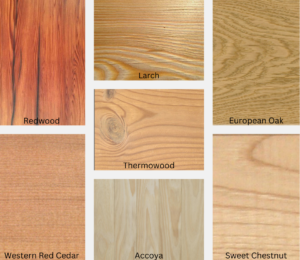
Brise Soleil and louvres can be made from several types of timber with the choice depending on factors such as climate, durability and design preferences. Here are some popular options we regularly work with:
Western Red Cedar
Western Red Cedar is the most common timber for brise soleil systems (as well as other façade and cladding projects) due to its natural resistance to decay and insects, it being lightweight and so easy to work with, and it’s beautiful reddish-brown appearance that weathers to a silver-grey colour.
European Oak
European Oak is available in a wide range of sizes and grades which gives it an almost unparalleled versatility. It offers a golden yellow brown appearance and has a distinctive grain with annual growth rings clearly visible on crown cut boards. It weathers to a natural silver colour if left uncoated. It finishes well and can be stained, polished, waxed and glued satisfactorily, which makes it a good option, albeit an expensive one.
Sweet Chestnut
Sweet Chestnut offers a light golden appearance and if left untreated, will patina to a natural silver colour. This species is generally straight grained, hard wearing and durable and renowned for its similarity to Oak, but at a more reasonable cost. This makes it an attractive option for brise soleil and louvre projects.
Accoya
Accoya is a modified type of timber that undergoes a process called acetylation to enhance its durability, stability and resistance to decay. It is the most stable species and has a life expectancy of 50 plus years. It is fire treatable although it is not easy to do and as a construction option is expensive so not always the best option for this reason.
Thermowood
Thermowood is a modified type of Scandinavian softwood timber that is produced by heat-treating at a very high temperature. During this heat treatment, chemical and structural changes occur within the timber which alter and improve some of its basic characteristics. The temperature removes some natural additives which create a better performance wood. It’s more resistant to swelling, cracking and shrinking (and rot and fungi) than natural wood and has increased longevity.
Be wary of other species for timber brise soleil applications
Other types of timber species such as Redwood and Siberian Larch have too much movement and twist across the spans required for solar shading systems and so are not as readily used or recommended.
Timber as a sustainable material
Timber stands out as an exceptionally sustainable material because it is a renewable resource that can be harvested responsibly. When forests are managed correctly, they can be continuously regrown and maintained for ongoing production.
As trees grow, they naturally absorb carbon dioxide from the atmosphere. Crucially, when this timber is used in construction, the material continues to store that carbon, significantly reducing a building’s overall carbon footprint. Using timber in design is therefore an effective strategy for sequestering carbon and actively combating climate change.
Furthermore, timber can be recycled and repurposed into new products or used as biomass for energy production. This reduces waste and extends the material’s usable lifecycle
To ensure the highest standards of environmental stewardship, Contrasol is committed to working exclusively with suppliers who provide fully certified timber in FSC, PEFC, SFI or CSA, depending on species and country of origin. By being part of these certification programs, companies can ensure their materials come from well-managed forests that prioritise biodiversity, conservation and long-term sustainability.
Effectiveness in solar shading systems
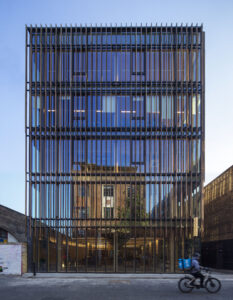
In addition to aesthetics and sustainability, timber is particularly effective in brise soleil systems due to its good insulating properties, which can help regulate temperature and reduce heat gain within a building. Similarly timber louvres, when properly designed, can promote natural ventilation by allowing air to flow through a building while blocking direct sunlight.
This can reduce the need for mechanical cooling systems, thus saving energy and reducing operational costs. It can also provide sound insulation and reduce noise pollution for louvres in areas with high noise levels. Finally, timber can be easily customized and shaped into various forms and profiles to create unique brise soleil and louvre designs. It can be stained, painted or finished in different ways to achieve the desired aesthetic and protection level making it an incredibly versatile material to work with.
Fire Safety
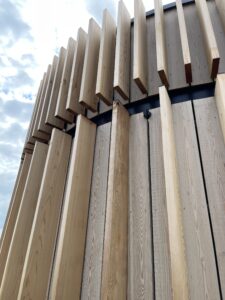
Fire safety affects all forms of construction but may be at the forefront of clients’ minds when considering the use of timber for external cladding and solar shading.
All buildings must, by law, be designed to comply
with the functional protocols of the Building Regulations for fire safety requirements as a minimum standard. Whilst timber is a combustible material, it has significant insulating properties and burns in a slow, predictable and measurable way. In fact, there is evidence to suggest that mass timber is actually safer in a fire than steel. In a fire, a thick plank of wood will char on the outside, sealing the interior and protecting it from damage. Fire retardant treatments can also be added to timber to further protect it from fire damage.
Conclusion
Timber is an excellent option for brise soleil and louvre projects due to its aesthetic appeal, sustainability, effectiveness in reducing heat gain and preventing noise pollution. Contrasol works with Vincent Timber to supply high quality, sustainably sourced timber that creates stunning results.

Discuss your timber Brise Soleil project
Speak to Contrasol’s team about bespoke timber Brise Soleil and screening systems designed to balance performance, sustainability, and architectural intent.
FAQs
Is timber suitable for use in Brise Soleil and screening systems?
Yes. When properly specified and treated, timber can perform well in Brise Soleil and screening applications, offering both durability and a natural aesthetic suitable for a wide range of building types.
How does timber Brise Soleil perform in terms of durability and maintenance?
Timber Brise Soleil systems are designed with durability in mind, using appropriate species, treatments, and detailing. Maintenance requirements depend on the timber type and desired finish, particularly where natural weathering is preferred.
When should timber Brise Soleil be considered within a project?
Timber Brise Soleil is ideally considered early in the design process so it can be fully integrated into the façade strategy. Timber can help architects create a softer, more natural feel to the façade, providing a strong visual contrast against glass, aluminium, or rendered walls. However, it can also be incorporated later in the process or introduced as part of refurbishment projects where appropriate.
Contrasol only works with suppliers who offer fully certified timber in FSC, PEFC, SFI or CSA, depending on species and country of origin. By being part of these certification programs, companies can ensure their materials come from well-managed forests that prioritise biodiversity, conservation and long-term sustainability.

