

Modular construction has emerged as a transformative force in the building and construction industry, reshaping how we think about efficiency, cost-effectiveness, and sustainability.
What Is Modular Construction?
Modular construction is when sections, known as modules, of a building are manufactured off-site in a controlled factory environment. Then, later assembled on-site. Unlike traditional construction methods, which typically involve building structures on-site and entirely in-situ, modular construction allows the structure and the site to be developed simultaneously. This significantly reduces project timeframes and boosts efficiency.
Notably, modular construction has expanded beyond standard residential and commercial building projects; it is now increasingly applied in the solar shading industry. Prefabricated modules for large scale projects such as car park façades and data centres, can be constructed, and installed quickly..
Why Modular Construction is Growing in Popularity
Modular construction is growing in popularity across many aspects of building design due to:
- Advances in technology and manufacturing
- Growing environment concerns
- A rise in sustainability requirements
- A demand to reduce project costs and timelines
- A need for more modern, efficient alternatives to traditional construction methods
- A need to improve quality control
Benefits of Modular Construction
The benefits of modular construction extend beyond speed. From improved quality control and reduced costs and environmental impact, modular building methods provide a suitable alternative to traditional construction. Here are the key advantages that highlight why modular construction is becoming the preferred choice across multiple sectors.
Faster Project Delivery
One of the most significant advantages of modular construction is the speed and efficiency it brings to the construction process. Because modules are constructed in a factory while site preparation, such as core structural framework is underway. Overall project timelines are typically 30-50% faster than traditional methods.
Improved Cost Efficiency
The efficiency of modular construction is further enhanced by the controlled environment of the factory, where resource management is optimised, waste is minimised, and labour costs are lower due to the repetitive nature of this approach. This makes modular construction not only faster but also more cost-effective.
Higher Quality Control
Quality control is another major benefit of modular construction. In a factory setting, modules are built to precise specifications under stringent quality control measures. This ensures a higher level of consistency and fewer defects compared to traditional on-site construction, where environmental factors like weather can impact the quality of the build.
More Sustainable
Additionally, the sustainability of modular construction is a key advantage. The method generates less waste, as materials can be more efficiently used and recycled in a factory setting. Furthermore, because modules are built indoors, the energy used during construction can be better managed. Modular buildings are also easier to deconstruct, allowing materials to be reused in other projects, further enhancing their sustainability credentials.
Challenges of Modular Construction
Despite its growing adoption and significant benefits, is not without its challenges. This construction method also presents a number of practical and perception-based disadvantages. Understanding these challenges is essential for building design teams considering modular construction projects.
Market Perception
The market has, at times, been resistant to this method, with a lingering perception that modular buildings are of lower quality or less durable than traditionally constructed structures. This perception is increasingly being disproven by advancements in the field, with modular buildings standing the test of time. However, it remains a hurdle that the industry must overcome.
Design Limitations
Design limitations also pose a challenge. While modular construction offers significant flexibility, it can be constrained by the need for modules to be transported and assembled. This often restricts the size and shape of modules, potentially limiting design possibilities. Architects and engineers must work within these constraints, which can sometimes lead to compromises in design.
Transportation Constraints
Large modules must be carefully designed to withstand the stresses of transportation, and their size is often limited by transportation regulations.
Complex Assembly
Once on-site, the assembly process requires precise alignment and integration, which can be complex and time-consuming.

High Upfront Investment
While modular construction can be more cost-effective in the long run, it often requires significant upfront investment. Factories need to be equipped with specialised machinery and technology, and the workforce must be trained in modular construction techniques. These initial costs can be a barrier for companies looking to adopt modular construction methods.
Examples of Modular Construction in Practice
Despite the challenges, there are numerous examples of successful modular construction projects across various sectors.
| Sector | Use Case | Result |
| Hospitality | Modular hotel room construction (e.g., Marriott International) |
|
| Healthcare | Modular hospital rooms (e.g., EIR Healthcare) |
|
| Residential | Modular homes and apartments (e.g., Katerra, Prefab Logic) |
|
Modular Construction in the Solar Shading Industry
Modular construction is also making its mark in the solar shading industry, offering innovative solutions for energy efficiency and building aesthetics. Solar shading systems are designed to control the amount of sunlight entering a building, reducing heat gain and glare while enhancing comfort and energy efficiency.
By incorporating modular construction techniques, these systems can be prefabricated off-site and quickly installed, providing several advantages. Modular solar shading systems can be tailored to the specific needs of a building, with modules designed to fit various window sizes and configurations. This flexibility allows for the creation of bespoke shading solutions that enhance both the aesthetic and functional aspects of a building.
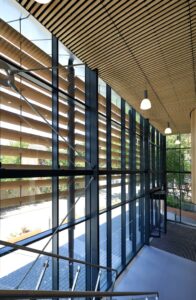
Just as with building construction, modular solar shading systems benefit from:
- Reduced installation times
- Prefabricated modules can be quickly assembled on-site
- Minimized disruption to building occupants
- Reducing labor costs.
These systems can also be seamlessly integrated into the overall design of a building, complementing its architectural features while providing effective solar control. Depending on the requirements of the project, you can choose from our High-Performance Sun Screens for engineered solar control or our Decorative Sun Screens for architectural expression. This integration not only enhances the building’s appearance but also contributes to its energy efficiency. Moreover, the modular approach allows for easy scalability, making it possible to replicate solar shading solutions across multiple buildings or large-scale projects. This ensures consistent quality and performance while reducing costs through economies of scale.
These systems can also be seamlessly integrated into the overall design of a building, complementing its architectural features while providing effective solar control. For projects that require performance-led solar control, explore our High-Performance Sun Screening solutions, and for visually driven façade treatments, view our Decorative Sun Screens. The modular approach also allows for easy scalability, making it possible to replicate shading solutions across multiple buildings or large-scale projects, ensuring consistent quality and reduced costs through economies of scale.
What Does Modular Construction Mean for the Future of Building Design?
Modular construction represents a major shift in the building industry, offering numerous benefits such as speed, cost-effectiveness, quality control, and sustainability. While it presents certain challenges, including design limitations, transportation issues, and upfront costs, the adoption of modular construction is growing, driven by successful examples across various sectors. As the construction industry continues to evolve, modular construction is likely to play an increasingly important role in shaping the future of building design and construction.
Explore Modular Solar Shading Solutions with Contrasol
As modular construction continues to reshape the way buildings are designed and delivered, the demand for fast, efficient façade elements is growing. Contrasol provides modular-ready solar shading systems that can be prefabricated off-site, installed quickly and engineered to deliver long-term performance.
If you are exploring modular sun shading options, planning a large-scale development or looking to reduce installation times, our team can support you.
FAQs
What does modular construction mean?
Modular construction refers to creating sections, or modules of a building, offsite in controlled factory conditions, then transporting and assembling them on-site.
Why is modular so popular?
Modular construction has become increasingly popular due to its ability to:
- deliver projects 30–50% faster
- reduce waste
- improve quality through factory-controlled production
- support sustainability goals
- offer greater cost certainty compared to traditional methods.
What are the benefits of modular construction?
Key benefits of modular construction include faster project delivery, higher quality-control, reduced waste, improved energy efficiency and lower environmental impact.
Can modular construction be used for façade and solar shading systems?
Yes. Modular solar shading and façade solutions allow for faster installation, improved quality control and repeatable performance. Contrasol frequently uses modular techniques for large-scale shading projects.

